The AI Labour Market Is Splitting in Two
Two months of Revelio Labs data. One consistent signal: AI isn't destroying the labour market — it's sorting it, ruthlessly, by seniority.
Two months of data from Revelio Labs' AI Labor Market Tracker reveal an economy that isn't simply losing jobs to AI — it's reorganising around it. The July and September 2026 editions tell a coherent but uncomfortable story: AI is creating two distinct labour markets within the same economy, and the dividing line is increasingly one of age and seniority.
The numbers shifted meaningfully between the two releases. Some improved on the surface; others quietly worsened beneath the headline. Reading both together is more revealing than either report alone.
The demand gap is narrowing — but the damage is already done
The headline demand number improved between the two reports. In July, job postings for the most AI-exposed occupations had fallen 42 percentage points relative to the least-exposed since October 2022. By September, that gap had narrowed to 29 percentage points. On the surface, that looks like relief.
Look closer, though, and it becomes clear that the narrowing reflects a labour market that has largely finished its initial adjustment — not one that is recovering. The structural shift away from hiring for AI-exposed roles has already happened. The marginal improvement in the gap doesn't mean those jobs are coming back; it means the shock has been absorbed and the new, lower baseline is becoming the norm.
The junior-versus-senior split makes this unmistakable. Both editions confirm that the demand decline is heavily concentrated at entry level. The most junior, most AI-exposed roles have been the first and hardest hit — and there is no sign of that dynamic reversing.
Young workers are bearing almost all the weight
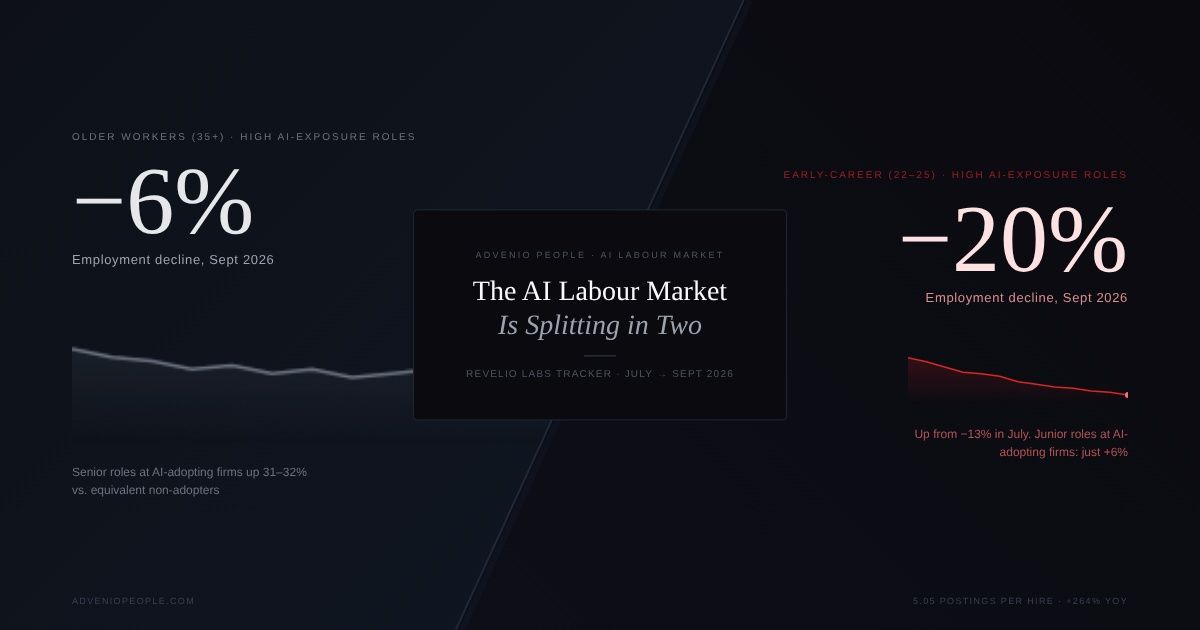
This is arguably the most striking finding across both reports. In July, employment for early-career workers (ages 22–25) in the most AI-exposed occupations was already down 13% relative to the least-exposed group since pre-ChatGPT. By September, that figure had jumped to 20%.
For older workers in the same high-exposure occupations, the September decline was just 6%.
The gap — 20 percentage points between young and older workers, both in equally AI-exposed roles — is not a technology story. It's a generational one. Workers who haven't yet had the chance to build track record, seniority, and institutional knowledge are the first to go when firms optimise their headcount around AI tools. Entry-level roles are being quietly phased out before they're even posted.
For anyone in recruiting — particularly startup recruiting, where junior hires are often the engine of early-stage growth — this data should prompt a real strategic question: what does the entry-level pipeline look like in two years?
Adoption is plateauing — but the firms that did it are pulling away
The wave of new AI adopters that crested in early 2026 is receding. From a peak in April, the rate of new firms starting to use AI tools has decelerated by 48%. This is not a crisis — it is a market maturing. The easy wins have been captured, and the firms that haven't adopted by now face a harder path: their competitors are already faster and cheaper.
What's striking is the internal effect on the firms that did adopt. Headcount at AI-adopting companies is up 26–27% compared to equivalent non-adopters. But the growth is sharply bifurcated. Senior roles at those firms are up 31–32%. Junior roles? Just 6%.
This is the clearest evidence yet that AI is not simply replacing workers — it is restructuring the ratio of senior to junior staff inside companies. When an AI tool can do the work that used to require three junior analysts, you hire one senior person to direct the tool and pocket the difference. The org chart doesn't shrink; it compresses.
For startups specifically, this creates a genuine structural tension. The traditional model — hire juniors cheap, develop them into seniors over time, build institutional knowledge — becomes harder to justify when AI tools shift the economics so decisively toward the experienced end. Yet the firms not doing AI at all are simply losing ground.
Work is changing inside roles, not just between them
The headline narrative around AI and employment focuses on which jobs disappear. The Revelio data suggests that framing misses the more important story.
In July, 87.3% of AI-driven activity change was happening within existing job titles — not between them. By September, that figure had risen to 90%. The shape of work is morphing faster than job categories are.
A financial analyst is still called a financial analyst. But the mix of what she does all day — the ratio of data retrieval to synthesis, of formatting to interpretation, of routine modelling to judgment calls — has shifted substantially. The job code is the same. The job is not.
This has a direct implication for recruiting. Skills and prior experience — the traditional proxies firms use to evaluate candidates — are becoming less reliable signals of future performance when the nature of every role is a moving target. The candidate who thrived in the same role at a competitor two years ago may have been optimised for a version of that work that no longer exists.
What firms actually need are people who can adapt as the role evolves, not just people who can perform the role as currently defined. That's a different hiring criterion, and most interview processes haven't caught up.
The matching market seized up — then partially cleared
Perhaps the most striking data point in the September report is the state of the job market's underlying mechanics. The postings-to-hire ratio — the number of open roles for every actual hire made — hit 5.05, up 264% year-over-year. That is not a tight market. That is a market in friction.
Employers are posting at near-record rates. Hires are not following. The two curves have decoupled.
The July report captured the worst of the dislocation. By September, something shifted: ghosting rates — the share of applications that receive no response — moved from a troubling +3% above baseline back to -1% below it. Firms started responding again. The clearing mechanism re-engaged, at least partially.
What explains the initial seize-up? The most plausible reading is that firms went on a posting spree while simultaneously revising their requirements upward, trying to find the unicorn candidate who was both AI-fluent and conventionally experienced. When no such pool materialised at the scale needed, they left postings open and went quiet on applicants.
The partial recovery in September suggests a correction: either expectations came down, or a new cohort of genuinely AI-capable candidates started moving through pipelines. Either way, the matching problem is structural, not temporary. Five postings per hire is not a blip.
What this means for startup recruiting
At Advenio, we work with startups and scaleups at the moment when hiring decisions carry outsized consequences. A bad executive hire at Series A costs more than money — it costs runway, culture, and momentum. The Revelio data sharpens several things we were already seeing in the market.
The senior talent premium is real and growing. With AI tools compressing the junior-to-senior ratio at adopting firms, competition for experienced operators is intensifying. The 31–32% headcount growth in senior roles at AI-adopting companies isn't happening in a vacuum — it's drawing from the same pool your clients are fishing in. Time-to-hire for senior roles will stay elevated. The process has to be sharper than it was two years ago.
The entry-level talent pipeline is thinning. A 20% employment decline for early-career workers in high-exposure roles has a delayed effect: the next cohort of mid-level managers is smaller. In three to five years, the scaleup looking for its first VP of Operations or Head of Finance will find that the traditional pipeline from junior analyst to senior associate to director has fewer people in it. Building that pipeline now — deliberately, with AI-adapted roles — is a strategic investment, not a nice-to-have.
Role definitions need updating before the search begins. If 90% of activity change is happening within roles, a job description written 18 months ago is recruiting for a job that no longer exists. Before opening a search, it's worth asking: what does this role actually require today, and what will it require in 12 months? The answer shapes not just the search criteria but the interview process and the onboarding plan.
The matching problem is your opportunity. A 5:1 postings-to-hire ratio signals that most employers are recruiting badly — posting widely, responding poorly, and misaligning requirements with available talent. For the startup that runs a disciplined, responsive, focused search, the friction in the broader market is an advantage. The best candidates are sitting in front of multiple open postings and hearing nothing. Show up differently.
The split is here. The question is which side you're on.
The two months between the Revelio July and September editions didn't change the direction of travel — they accelerated it. Demand for AI-exposed roles is recovering, but young workers are falling further behind. AI adoption has peaked for now, but the firms that adopted are compounding their advantage. Matching is partially clearing, but structural friction remains.
The labour market is not collapsing. It is differentiating — between companies that have adapted and those that haven't, between experienced workers who have reoriented their skills and those who haven't, between hiring processes that are precise and those that are noisy.
For startups and scaleups, this is both a risk and an opening. The risk: talent strategies built for the pre-AI market will produce slower, more expensive, lower-quality hires. The opening: the bar for running a better process than your competitors has never been lower, because most of them are getting it wrong.
Data sourced from the Revelio Labs AI Labor Market Tracker, July 2026 and September 2026 editions. Revelio Labs tracks AI's effect on the US labour market across supply, demand, equilibrium, work content, and matching dimensions.

Insight by Bjørn Andersen
Bjørn Andersen
CEO & Founder
CEO & Founder